Friday, August 30, 2013

Newest GuruFocus Investor - Paul Singer of Elliott Management

Paul Singer, founder of $17 billion hedge fund Elliott Management, is the newest investor GuruFocus has chosen to track. Singer has a background in law that set the stage for his formidable distressed debt tactics he has used to profit from bankrupt companies and sue sovereign nations. From 1977, the year he founded his firm (making it one of the oldest hedge funds), to November 2010, he had an annualized net return of 14.4%. As one of the few to foresee and warn of the pending housing crisis in 2008, his fund was only down 3.08% in 2008, compared to the S&P 500 which was down 37% the same year.

Singer graduated from the University of Rutgers with a B.S. in psychology and then obtained a J.D. from Harvard Law School. He practiced law for four years after graduation at corporate law firms and Donaldson, Lufkin & Jenrette, an investment bank.

As an example of Singer's distressed debt investing is his profitable stake in Delphi, the bankrupt auto parts supplier. According to the New York Post, Elliott Management and partner Silver Point Capital held an 18% stake in Delphi when it emerged from bankruptcy in October 2009. At the time that Delphi exited bankruptcy, the stake was worth $640 million. By October 2010 it had more than doubled to $1.54 billion.

When Elliott entered the Delphi deal, the company's bankruptcy had been stalled in court for four years, and GM, the Treasury and an auto task force wanted to privatize the company and sell it to a private-equity firm that would not have been profitable for lenders. Elliott Management and its partner instead bought $2.9 billion worth of Delphi loans for about 15 cents on the dollar and used the position to block the sale.

Singer 's team managed a deal with the government and lenders and told them, "You can either take it or try to fight it in court," the New York Post reported.

Singer had also bought debt of Chrysler and Lehman Brothers, and has taken activist equity stakes in Novell and Iron Mountain (IRM! ).

He sued his first nation in 1996, when his firm bought defaulted debt of Peru. After a lengthy legal battle and the overturning of a law that stood in his way, Elliott received a $58 million judgment on his $11 million investment, according to Fortune. He has also sued Congo-Brazzaville, Argentina, and several other countries using the controversial tactic that some say disenfranchises the people of the countries with indebted governments.

Elliott has strong opinions about the governments of the U.S., Japan and Europe as well. He often pens impassioned but heavily guarded quarterly letters expressing his thoughts on the economy and his extremely republican viewpoints. He is also a major donor to conservative political candidates. Staunchly opposed to Fed's handling of the financial crisis and stimulus plan, he said in one of his letters obtained by DealBook in August 2010:


"Instead of addressing the unsound financial system by deleveraging the banks, making them understandable and transparent, and modernizing the regulatory scheme, the bulk of the actions taken by the new government, starting in early 2009, consisted of an ideological wish-list and cronyism. Very little was oriented toward supporting the private sector, except for the surviving banks, which were nursed back to 'health' (that is, mostly as highly-leveraged trading shops) with lavish dollops of close-to-free money and blanket guarantees."

Some of Elliott Management's top equity positions in the first quarter 2012 are Brocade Communications Systems (BRCD), Delphi Automotive (DFG), Iron Mountain (IRM) and News Corp. (NWS).

Paul Singer's portfolio will be added to GuruFocus soon.

Top 5 Warren Buffett Stocks To Buy Right Now

Wednesday, August 28, 2013

Progressive Tops Earnings on Higher Premiums - Analyst Blog

Hot Financial Companies To Invest In Right Now

Progressive Corp.'s (PGR) earnings per share for the second quarter of 2013 were 54 cents, surging nearly 176% from 19 cents in the year-ago quarter. The result also surpassed the Zacks Consensus Estimate of 40 cents. Net income shot up 174% from the second quarter of 2012 to $324.6 million in the reported quarter.

Progressive recorded net premiums of $4.4 billion in the quarter under review, up 6% from $4.1 billion in the year-ago quarter. Net premiums earned were $4.3 billion, up 7% from $4.0 billion in the year-ago quarter.

Net realized gains on securities in the quarter were $132.9 million, rebounding from a loss of $4.7 million in the year-ago quarter. Combined ratio − the percentage of premiums paid out as claims and expenses − improved 430 basis points from the prior-year quarter to 93.3% in the reported quarter.

Numbers in June

Progressive publishes monthly financial reports. During June, policies in force remained healthy, with the Personal Auto segment increasing 1% year over year and 0.1% sequentially. Special Lines increased 1% year over year and 0.6% sequentially.

In Personal Auto, Direct Auto grew 2% year over year and 0.3% from the preceding month. Agency Auto declined 1% year over year, although it improved 0.01% from the preceding month. Progressive's Commercial Auto segment grew 0.3% year over year.

Total expenses for the reported month increased 3.3% to $1.35 billion from $1.26 billion in Jun 2012. The major components contributing to the increase in total expenses were a 5% increase in losses and loss adjustment expenses.

Progressive reported book value per share of $10.87, up from $10.32 as of Jun 30, 2012 but down from $10.98 as of May 31, 2013.

Return on equity on a trailing 12-month basis was 17.9%, up from 12.5% in Jun 2012 but down from 19.9% in May 2013. The d! ebt-to-total-capital ratio was 24.4% as of Jun 30, 2013, down from 24.7% as of Jun 30, 2012 but slightly up from 23.8% as of May 31, 2013.

Progressive carries a Zacks Rank #2 (Buy). Insurers Alleghany Corporation (Y), American Safety Insurance Holdings Ltd. (ASI) and AmTrust Financial Services, Inc. (AFSI), among others, also carry a Zacks Rank #1(Strong Buy) and appear impressive.

Tuesday, August 27, 2013

Camping for Free or Really, Really Cheap

Saving money matters but so does having a good time on vacation. Vacations, in general, tend to be expensive, although there are ways to save money – even when traveling in style.

Related: Cruise Away – It's Safe and Here's How to Save

On the other hand, if you enjoy the rugged outdoors, you might be able to travel for far less than you think.

Almost 40 million Americans participated in camping last year, according to a recent study by The Outdoor Foundation. That represents more than 14 percent of Americans over the age of six.

Many of those people choose to camp, "on the cheap." They spend little or nothing for overnight accommodations, get to see amazing sights, and come home with money in their pocket.

Here's how they do it.

Wilderness Areas

According to BargainBabe, one way to save is to camp in wilderness areas. A wilderness area is a tract of protected land where everything is in a natural state. Camping there may require a permit, but frequently there is no cost.

Cars and other mechanized vehicles are generally not allowed. To get to a camping area you must hike, canoe, or travel by horseback. In most cases campsites are not marked – you find your own – in the woods. Typically, wilderness areas allow you to hunt, fish, or hike. With no running water or toilets, you may have to treat local stream or lake water and dig a pit for waste.

To learn more, go to Wilderness.net.

Bureau of Land Management

According to the U.S. Bureau of Land Management, 89 percent of BLM land is free to camp on. As with wilderness areas in general, some BLM locations require a permit, others do not. In addition, as with most wilderness areas, BLM sites are bare bones – as in no water, electricity, or bathroom facilities.

However that doesn't mean the experience is always primitive. Kevin Mack, campaign director at the Wilderness Society in Washington, D.C., told BargainBabe, "I have done car camping on BLM lan! d. You can bring a cooler and have a gin and tonic at the end of the day. The only difference is you are by yourself and you have to think creatively about your bathroom facilities."

A portion (about 10 percent) of BLM land is managed by the National Landscape Conservation System, and features more traditional camping options for a nominal cost.

For more information about BLM camping go to the BLM national website.

National Forests

National Forests – not to be confused with National Parks, where fees and traffic are higher – are mostly free or inexpensive. Many have actual campgrounds, although amenities vary widely. National forests that are frequently visited typically have better campgrounds – and fees.

The U.S. Forest Service recreation website has state-by-state links with complete information.

Other Free or Low Cost Options

The primary focus of Freecampsites.net is government land but the site also lists other options, including retail parking lots suitable for pulling over an RV for the night. The website features a map-based search engine to help you locate free or low cost camping options.

FreeCampground.com could be helpful if you have an RV and are seeking free or low cost camping options. The site claims to offer 17, 000 with more being listed all the time.

Another RV-based site, FreeCampgrounds.com, (different by the one above by a single letter), primarily lists places to park overnight for under $10. Many sites on the list, which includes parks, rest areas, parking lots, and more, are free.

Finally, RVCamping.org provides an interactive state-by-state map of all manner of low-cost (and free) RV camping options. The site also includes a plethora of camping information, including tips for newbies, guides to government lands, and much more.

(c) 2013 Benzinga.com. Benzinga does not provide investment advice. All rights reserved.

Monday, August 26, 2013

Will Best Buy Continue Its Recovery?

With shares of Best Buy (NYSE:BBY) trading around $26, is BBY an OUTPERFORM, WAIT AND SEE, or STAY AWAY? Let's analyze the stock with the relevant sections of our CHEAT SHEET investing framework:

T = Trends for a Stock’s Movement

Best Buy is a multinational retailer of consumer electronics, computing and mobile phone products, entertainment products, appliances, and related services. The company operates retail stores and call centers, and conducts online retail operations under a range of brand names, such as Best Buy, Best Buy Mobile, The Carphone Warehouse, Five Star, Future Shop, Geek Squad, Magnolia Audio Video, Pacific Sales, and The Phone House. Best Buy operates in two segments: Domestic and International. Electronic products hold the interest of consumers and companies worldwide and will continue to do so. As economies around the world develop, Best Buy is poised to provide the products and services consumers demand. However, in order for Best Buy to see huge success, it must be able to successfully compete against its online competitors.

NEW! Discover a new stock idea each week for less than the cost of 1 trade. CLICK HERE for your Weekly Stock Cheat Sheets NOW!

T = Technicals on the Stock Chart are Strong

Best Buy stock is seeing a powerful bounce after a few years of increased selling. The stock has more than doubled just this year and looks to continue this euphoric rise. Analyzing the price trend and its strength can be done using key simple moving averages. What are the key moving averages? The 50-day (pink), 100-day (blue), and 200-day (yellow) simple moving averages. As seen in the daily price chart below, Best Buy is trading above its rising key averages which signal neutral to bullish price action in the near-term.

BBY

(Source: Thinkorswim)

Taking a look at the implied volatility (red) and implied volatility skew levels of Best Buy options may help determine if investors are bullish, neutral, or bearish.

Implied Volatility (IV)

30-Day IV Percentile

90-Day IV Percentile

Best Buy Options

69.54%

86%

84%

What does this mean? This means that investors or traders are buying a very significant amount of call and put options contracts, as compared to the last 30 and 90 trading days.

Put IV Skew

Call IV Skew

June Options

Flat

Average

July Options

Flat

Average

As of today, there is an average demand from call buyers or sellers and low demand by put buyers or high demand by put sellers, all neutral to bullish over the next two months. To summarize, investors are buying a very significant amount of call and put option contracts and are leaning neutral to bullish over the next two months.

On the next page, let’s take a look at the earnings and revenue growth rates and the conclusion.

E = Earnings Are Mixed Quarter-Over-Quarter

Rising stock prices are often strongly correlated with rising earnings and revenue growth rates. Also, the last four quarterly earnings announcement reactions help gauge investor sentiment on Best Buy’s stock. What do the last four quarterly earnings and revenue growth (Y-O-Y) figures for Best Buy look like and more importantly, how did the markets like these numbers?

2012 Q4

2012 Q3

2012 Q2

2012 Q1

Earnings Growth (Y-O-Y)

75.35%

-107.14%

-91.49%

31.43%

Revenue Growth (Y-O-Y)

38.12%

-5.23%

-3.59%

-26.20%

Earnings Reaction

4.57%

-13.01%

-1.37%

1.59%

Best Buy has seen mixed earnings and revenue figures over the last four quarters. From these figures, the markets have been a bit confused with Best Buy’s recent earnings announcements.

NEW! Discover a new stock idea each week for less than the cost of 1 trade. CLICK HERE for your Weekly Stock Cheat Sheets NOW!

P = Excellent Relative Performance Versus Peers and Sector

How has Best Buy stock done relative to its peers, Amazon (NASDAQ:AMZN), Apple (NASDAQ:AAPL), Wal-Mart (NYSE:WMT), and sector?

Best Buy

Amazon

Apple

Wal-Mart

Sector

Year-to-Date Return

122.2%

6.89%

-19.04%

16.74%

23.25%

Best Buy has been a relative performance leader, year-to-date.

Conclusion

Best Buy provides highly demanded electronic products and services to consumers and growing companies worldwide. The stock is seeing an incredible bounce after a few years of significant selling pressure. Earnings and revenue figures are improving, but investors expect more from the company. Relative to its peers and sector, Best Buy has led by an extremely wide margin. Look for Best Buy to OUTPERFORM.

5 Stocks Under $10 Set to Soar

DELAFIELD, Wis. (Stockpickr) -- There isn't a day that goes by on Wall Street when certain stocks trading for $10 a share or less don't experience massive spikes higher. Traders savvy enough to follow the low-priced names and trade them with discipline and sound risk management are banking ridiculous coin on a regular basis.

Just take a look at some of the hot movers in the under-$10 complex from Wednesday, including Unilife (UNIS), which ripped higher by 11.6%; Hanwaha Solarone (HSOL), which soared higher by 9.8%; Bio Telemetry (BEAT), which jumped higher by 8.6%; and ArQule (ARQL), which trended up 8%. You don't even have to catch the entire move in lower-priced stocks such as these to make outsized returns when trading.

Low-priced stocks are something that I tweet about on a regular basis. I frequently flag high-probability setups, breakout candidates and low-priced stocks that are acting technically bullish. I like to hunt for low-priced stocks that are showing bullish price and volume trends, since that increases the probability of those stocks heading higher. These setups often produce monster moves higher in very short time frames.

I'm not as eager to recommend investing long-term in stocks that trade less than $10 a share because these names can be very speculative, and the odds for picking the long-term winners aren't great. But I definitely love to trade stocks that are priced below $10. I like to view them as a trading vehicle with lots of volatility and lots of upside when the trade is timed right.

When I trade under-$10 names, I do it almost entirely based off of the charts and technical analysis. I also like to find under-$10 names with a catalyst, but that's secondary to the chart and volume patterns.

With that in mind, here's a look at several under-$10 stocks that look poised to potentially trade higher from current levels.

ReneSola


One under-$10 name that's starting to move within range of triggering a big breakout trade is ReneSola (SOL), a manufacturer of solar wafers and producer of solar power products based in China. This stock has been on fire so far in 2013, with shares up sharply by 183%.

If you take a look at the chart for ReneSola, you'll notice that this stock has been uptrending very strong for the last four months and change, with shares soaring higher from its low of $1.25 to its recent high of $4.85 a share. During that uptrend, shares of SOL have been consistently making higher lows and higher highs, which is bullish technical price action. Shares of SOL have pulled back a bit during the last few weeks, with the stock coming off that high of $4.85 to its recent low of $3.52 a share. This stock has now started to bounce off that $3.52 low and it's quickly moving within range of triggering a big breakout trade.

Traders should now look for long-biased trades in SOL if it manages to break out above some near-term overhead resistance levels at $4.25 to $4.50 a share and then once it clears its 52-week high at $4.85 a share with high volume. Look for a sustained move or close above those levels with volume that hits near or above its three-month average action of 2.09 million shares. If that breakout triggers soon, then SOL will set up to enter new 52-week-high territory, which is bullish technical price action. Some possible upside targets off that breakout are $7 to $8 a share.

Traders can look to buy SOL off any weakness to anticipate that breakout and simply use a stop that sits right below its 50-day moving average of $3.31 a share. One can also buy SOL off strength once it takes out those breakout levels with volume and then simply use a stop that sits a comfortable percentage from your entry point.

James River Coal

Another under-$10 energy player that's starting to move within range of triggering a near-term breakout trade is James River Coal (JRCC), which is engaged in mining, processing and selling thermal and metallurgical coal through eight active mining complexes located throughout eastern Kentucky, southern West Virginia and southern Indiana. This stock has been hit hard by the sellers so far in 2013, with shares off by 38%.

If you take a look at the chart for James River Coal, you'll notice that this stock has been trending sideways for the last two months inside of a consolidation pattern, with shares moving between $1.70 on the downside and $2.32 on the upside. Shares of JRCC are now starting to trend back above its 50-day moving average of $1.94 a share. That move is quickly pushing JRCC within range of triggering a near-term breakout trade above the upper-end of its recent sideways trading chart pattern.

Market players should now look for long-biased trades in JRCC if it manages to break out above some near-term overhead resistance levels at $2.20 to $2.32 a share and then once it clears its 200-day moving average at $2.48 a share with high volume. Look for a sustained move or close above those levels with volume that registers near or above its three-month average volume of 1.16 million shares. If that breakout triggers soon, then JRCC will set up to re-test or possibly take out its next major overhead resistance levels at $2.88 to $3.50 a share, or possibly even $4 a share.

Traders can look to buy JRCC off any weakness to anticipate that breakout and simply use a stop that sits right below some key near-term support levels at either $1.74 or at $1.70 a share. One can also buy JRCC off strength once it clears those breakout levels with volume and then simply use a stop that sits a comfortable percentage from your entry point.

McDermott International

One under-$10 engineering player that's trending very close to triggering a big breakout trade is McDermott International (MDR), an engineering, procurement, construction and installation company engaged on designing and executing complex offshore oil and gas projects. This stock has been hit hard by the bears so far in 2013, with shares off by 31%.

If you take a look at the chart for MDR, you'll notice that this stock recently gapped down sharply from close to $9 a share to its recent low of $6.68 a share with heavy downside volume. Following that move, shares of MDR have started to rebound off that $6.68 low, and the stock is now starting to move within range of triggering a major breakout trade.

Traders should now look for long-biased trades in MDR if it manages to break out above some near-term overhead resistance at $7.74 a share with high volume. Look for a sustained move or close above that level with volume that hits near or above its three-month average action of 4.33 million shares. If that breakout triggers soon, then MDR will set up to re-fill some of its previous gap down zone from August that started near $9 a share. If MDR gets into that gap with volume, then this stock could easily hit $9 to $10 a share.

Traders can look to buy MDR off weakness to anticipate that breakout and simply use a stop that sits right below some near-term support levels at $7.04 o around its recent low of $6.68 a share. One can also buy MDR off strength once it takes out $7.74 a share with volume and then simply use a stop that sits a comfortable percentage from your entry point.

Aluminum Corp. of China

Another under-$10 basic materials player that's starting to move within range of triggering a big breakout trade is Aluminum Corp. of China (ACH), a vertically integrated aluminum producer. This stock has been under pressure so far in 2013, with shares off by 27%.

If you take a look at the chart for Aluminum Corp. of China, you'll notice that this stock has been uptrending strong for the last two months, with shares moving higher from its low of $7.24 to its recent high of $8.86 a share. During that uptrend, shares of ACH have been making mostly higher lows and higher highs, which is bullish technical price action. That uptrend is coming after shares of ACH plunged lower from $10.73 to $7.24 a share between May and June. This stock has now started to trend back above its 50-day at $8.10 a share and it's quickly moving within range of triggering a big breakout trade.

Market players should now look for long-biased trades in ACH if it manages to break out above some near-term overhead resistance at $8.86 a share with high volume. Look for a sustained move or close above that level with volume that hits near or above its three-month average action of 111,653 shares. If that breakout triggers soon, then ACH will set up to re-test or possibly take out its next major overhead resistance levels at its 200-day moving average of $10.02 a share to around $11 to $12 a share.

Traders can look to buy ACH off weakness to anticipate that breakout and simply use a stop that sits right below its 50-day moving average of $8.10 a share, or below more near-term support at $7.66 a share. One can also buy ACH off strength once it clears $8.86 a share with volume and then simply use a stop that sits a comfortable percentage from your entry point.

Mindspeed Technologies

One final under-$10 semiconductor player that looks ready to trigger a major breakout trade is Mindspeed Technologies (MSPD), which designs, develops and sells semiconductor networking solutions for communications applications in enterprise, access, metropolitan and area networks. This stock has been under control of the bears so far in 2013, with shares off by 35.9%.

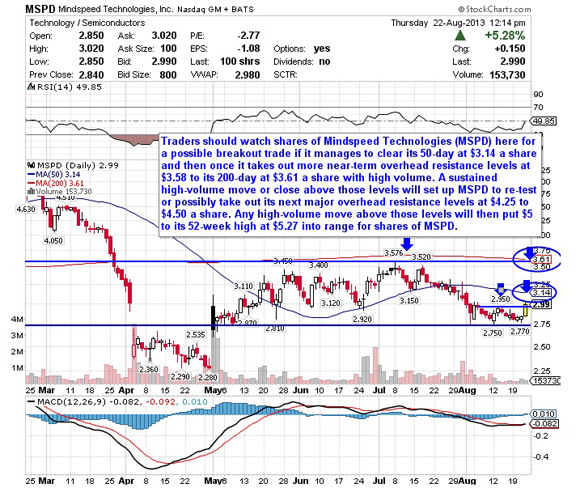
If you take a look at the chart for the Mindspeed Technologies, you'll notice that this stock has been trending sideways for the last four months inside of a consolidation pattern, with shares moving between $2.75 on the downside and $3.58 on the upside. Shares of MSPD have pulled back in the last two months from that $3.58 a share to $2.75 a share. The stock has formed a near-term double bottom off that pullback at $2.75 to $2.77 a share. Shares of MSPD are now starting to break out above some near-term overhead resistance at $2.95 a share today. That move is quickly pushing MSPD within range of triggering a major breakout trade.

Traders should now look for long-biased trades in MSPD if it manages to break out above its 50-day at $3.14 a share and then once it takes out more near-term overhead resistance levels at $3.58 to its 200-day at $3.61 a share with high volume. Look for a sustained move or close above those levels with volume that hits near or above its three-month average action of 479,780 shares. If that breakout triggers soon, then MSPD will set up to re-test or possibly take out its next major overhead resistance levels at $4.25 to $4.50 a share. Any high-volume move above those levels will then put $5 to its 52-week high at $5.27 into range for shares of MSPD.

Traders can look to buy MSPD off weakness to anticipate that breakout and simply use a stop that sits right below some key near-term support levels at $2.77 to $2.75 a share. One can also buy MSPD off strength once it clears those breakout levels with volume and then simply use a stop that sits a comfortable percentage from your entry point.

To see more hot under-$10 equities, check out the Stocks Under $10 Setting Up to Explode portfolio on Stockpickr.

-- Written by Roberto Pedone in Delafield, Wis.

Saturday, August 24, 2013

LPL’s New Supervisory Rules Will Cost Reps

LPL Financial (LPLA) announced on Monday that it is no longer allowing standalone reps to be their own supervisors (but they can keep their Series 24 and 26 licenses). Independent broker-dealer recruiter Jon Henschen, citing a LPL Financial registered rep, said that going forward, they will need to do one of the following:


— Be under a multi-rep office of supervisory jurisdiction (OSJ)

— Be supervised through the home office, which will cost an additional $4,800 per year

— Be tied to one of their institutional affiliates (such as bank channel)

Jonathan Henschen“LPL has a high number of standalone reps, so this move will cause a lot of controversy and ultimately outflow to other firms,” Henschen (right) told ThinkAdvisor. “The additional $4,800 per year for home office supervision is an unusually high cost, which makes an already expensive broker-dealer now one of the most expensive.”

He added that most of the firms with which he works supervise all their reps and cover that expense through the revenue they generate via the payout grid.  

“LPL Financial reps will either have to eat the $4,800 by going in under the company, or go to a multi-rep OSJ that will take 5% of their payout. Either way it’s an added cost. With all the bad press LPL has been getting lately, it was a move to appease FINRA. It’s one more thing that will drive reps to other firms.”

Whether or not Henschen’s assessment proves accurate is far from settled. In June, the broker-dealer behemoth announced that its RIA platform reached $50 billion in assets under custody, nearly doubling its asset base of a year ago. LPL’s RIA platform was used by 152 firms with $27.1 billion in assets as of March 2012. In late May 2013, 208 firms with $50 billion in assets were doing business on the platform.

LPL Financial emailed the following statement on Wednesday:

“LPL Financial is beginning a process to transition advisors operating as single-person Offices of Supervisory Jurisdiction (OSJs) to a new model under which LPL home office supervisors will serve as the OSJ. This will impact roughly 2,200 single person OSJs (SPOs). Under this new model, SPOs will have the option to:

Transition to Home Office Supervision or join an existing qualified multi-person Office of Supervisory Jurisdiction (OSJ). An OSJ is a field office with a Registered Principal, who is qualified to supervise other advisors. Under Home Office Supervision (HOS), advisors are supervised by principals in LPL’s home office.

This transition is the latest in a series of steps taken by LPL Financial to strengthen compliance oversight across the organization, and ensure the company is well positioned for sustainable growth and success. The company has been working on this for some time, underscoring how LPL Financial has been proactively looking for continuous improvement opportunities while also being responsive to new regulatory rules related to practice management. In addition, a major factor has been FINRA’s soon-to-be-enacted consolidated supervision Rule 3110 that will require firms, among other things, to adopt a new on-site supervisory structure for SPOs using designated “senior principals.”

Monday, August 19, 2013

Gold, certainly getting very precious...

The mantra for gold investment has become pretty clear� "Any positive news that hits the market, we get an opportunity to buy at dips, but incase of negative news we see buying at current market price" this is the trend followed in the market so far.

Although prices of gold have scaled above Rs 29000 per 10 gm in the Indian markets, surged past USD 1,800 per ounce in the international markets, but the trend still looks very much positive with every dip seen as a buying opportunity to accumulate. Gold has been the best performer among all the asset classes with positive QoQ returns post 2008 crisis and have rallied more than 10% in the current quarter so far. Gold's current bull rally has been supported by strong price driver, which are away from the technical factors�We call them the fundamental price drivers. Some of them are discussed below:

Investment and jewellery demand: With increase in number of gold backed Exchange traded funds (ETF's) around the world, spread of knowledge among investors due to increased literacy, high disposable income, etc have helped growth in the investment demand, especially after the 2008 debt-crisis.

ETF's provide the facility to invest in small quantities (as low as 1gram of gold), that are affordable to every participant in market.  Majority of the participants includes retail investors, hedge funds, pension funds, etc. Physical demand too remains robust be it for gold coins or bars or the any kind of jewelry, especially from India and China.

Economic uncertainties

Inflation: High inflation levels have become a major concern for central banks in the global market and especially in the emerging economies, mainly due to expanded money supply in the form of bail-out packages, stimulus, etc. Although strong steps have been initiated by the concerned central banks but no major impact is seen & inflation still remains at elevated levels. Historically, gold is considered as a best hedge against inflation.

Low interest rates: Absence of alternative safe investments has pushed investors towards gold with interest rates close to zero among majority of the developed economies and high volatility in the equity, currency & commodity markets, have added further support to the gold�s safe haven demand.

Debt crisis: This has been the major recent factor that has driven gold prices higher, first it was the United States raising its debt ceiling & then hit by a credit rating downgrade� now, it's the European Union, which is facing a tough job in baling out its members from increasing sovereign debts.

Proposal for 50% write-off in Greece's debt has been recommended while other nations like Italy, Spain, Ireland, Portugal and Belgium are already burdened with high debt levels, seeking immediate steps today or tomorrow. Any strong measure taken by the EU is likely to impact the union's strongest economies i.e. France & Germany. But the big questions remains, where is it going after Europe, is it Asia??

Apart from the economic factors discussed above, certain factors such as high unemployment, central bank actions, slowing industrial & economic growth, low consumer confidence in the west, etc have remained supportive to gold current up-trend.

High crude prices: Oil prices are again moving close to USD 100 per barrel and with Brent prices already above USD 110 per barrel, are again raising alarm over the impact it could have on the balance sheet of major importing nations while the growth of global economy continues to slow with no major signs of revival seen till date. High energy prices leads to increased input cost, which is turn increases the cost of final output, ultimately leading to high inflation and high debt levels, indirectly making gold as the best alternative for savings.

Dollar factor: The US dollar is a global accepted currency, with most of the currencies directly pegged to the US dollar in terms of central bank reserves, international transactions, quotes, etc. However, declining value of the US dollar against its major trading partners after 2008 crisis, has raised questions over dollars future as an international currency while many experts seen talking about bringing back gold standard.

There has been many factors responsible for dollar decline, right from debt crisis to high unemployment rates to slow pace of GDP growth to fragile housing market, etc all in the US. Historically, the value of US dollar is inversely proportional to that of gold (i.e. Dollar up - gold down, dollar down -gold up), but the impact is not always strong, as there are many other economic & non-economic factors outside the US.

Best alternative investment (compared with equities, property markets, etc): In the current market scenario, where there is high amount of uncertainty in the stocks & bonds, currency markets are highly volatile (both reacting swiftly to the economic activities), property prices at sky highs & out of the reach of small investors. So, for them gold remains the best alternative, as it can be purchased in small quantities and accumulated.

Central bank gold reserves: According to market reports, central banks across the globe have remained net buyers of gold, loosing their confidence in the paper money after 2008 debt crisis. Asian central banks have remained the major buyer's of gold lead by India and China. And, with regards to central banks gold sells in the open market, most of the countries are happy to keep their holdings in vault considering the market situation and uncertainty in the currency markets.

Currency market volatility: High volatility is seen in the currency markets with every central bank trying to keep its currency stable i.e. from appreciating/ depreciating sharply with monitory policy actions, intervening in the markets, etc.  In addition to this, changes in the macros economic factors are being closely watched by market participants, who are continuously increasing their bets on high gold prices.

These were some of the demand factors, but on the Supply side, it has been noticed that supply growth has not kept its pace with the demand growth, mainly due to lower output in South Africa, one of the world�s largest producers of gold. Also China & Australia overtook South Africa as the world�s largest producers of gold in 2007. Although supply has been increases steadily, but less is seen supplied to the market as central banks of respective producing countries are purchasing their domestic output and adding the same to their reserves.

Outlook:
Increased demand for gold and its products from every class of investors, for diversifying their portfolio, managing the long-term returns and a store of wealth. The long-term picture of gold certainly looks positive with every dip seen as a buying opportunity to accumulate, with ongoing uncertainty in the global market in terms of macro-economic fundamentals, debt issues and growing investment demand even at current higher prices.

Sunday, August 18, 2013

Best Clean Energy Stocks To Invest In 2014

I went out on a limb last week, and now it's time to see how that decision played out.

I predicted that Clean Energy Fuels (NASDAQ: CLNE  ) would close higher on the week. The provider of natural gas fueling solutions for transportation has been posting narrowing losses, and Wall Street was eyeing a 35% surge in revenue. The company was a solid report. Revenue came in a little light, but bottom-line results improved nicely. Shares of Clean Energy Fuels moved slightly higher on the week. I was right. I predicted that the tech-heavy Nasdaq would outperform the Dow Jones Industrial Average. (DJINDICES: ^DJI  ) . This has been a tricky call lately, so how did it play out this time? Well, the market had a strong run this week, fueled be encouraging economic news. Secondary stocks led the way, with the Nasdaq soaring 1.7% on the week. The Dow managed to close just 1% higher. I was right. My final call was for Compass Diversified Holdings (NYSE: CODI  ) to beat Wall Street's quarterly profit target. The investor in several middle-market companies has been posting blowout quarterly results over the past year, and I was banking on seeing the trend continue. Analysts were looking for a profit of $0.36 a share during the quarter, but Compass Diversified failed to beat the prognosticators. I was wrong.

Two out of three? I'll take it. That makes me eight of nine over the past three weeks.

Best Clean Energy Stocks To Invest In 2014: Carrols Restaurant Group Inc.(TAST)

Carrols Restaurant Group, Inc., through its subsidiary, Carrols Corporation, owns and operates quick-casual and quick-service restaurants. It operates restaurants under the Burger King, Pollo Tropical, and Taco Cabana names. As of January 1, 2012, the company owned and operated 547 restaurants, including 298 Burger King, 91 Pollo Tropical and 158 Taco Cabana restaurants in 17 states in the United States. It also franchised 36 restaurants in Puerto Rico, Ecuador, Honduras, Trinidad, the Bahamas, and Venezuela, as well as in college campuses in Florida. The company was formerly known as Carrols Holdings Corporation and changed its name to Carrols Restaurant Group, Inc. in November 2006. Carrols Restaurant Group, Inc. was founded in 1960 and is headquartered in Syracuse, New York.

Best Clean Energy Stocks To Invest In 2014: VES(VES.AX)

Vesture Limited, a national property management company, engages in the management of strata plans in Australia. The company, formerly known as Australian Institute of Property Management Limited, is based in Sydney, Australia.

Best Stocks To Own Right Now: Dios Exploration Inc (DOS.V)

Dios Exploration Inc., a mineral research company, operates as a mining exploration and evaluation company in Canada. It focuses on exploring gold, uranium, diamonds, and a carbonatite with rare earth and niobium metals. The company holds interests in various properties comprising 5,300 mining claims covering approximately 2,750 square kilometers in the areas of central Quebec and the Otish Mountains. Dios Exploration Inc. is based in Montreal, Canada.

Saturday, August 17, 2013

Hot Performing Companies To Buy Right Now

Intel (NASDAQ: INTC  ) is scheduled to release its quarterly earnings report tomorrow, and the chip giant has a lot riding on this particular quarter. With the company's earnings expected to contract not only in this quarter but throughout 2013, Intel could have trouble shedding its reputation as one of the worst-performing stocks in the Dow Jones Industrials (DJINDICES: ^DJI  ) during 2012.

But Intel has come a long way from its PC-reliant days. Although it still suffers when dropping PC demand limits the need for its legacy PC microprocessors, Intel has finally made some progress in getting itself into the mobile arena in force. Let's take an early look at what's been happening with Intel over the past quarter and what we're likely to see in its quarterly report.

Hot Performing Companies To Buy Right Now: Long Harbour Capital Corp (LHC.V)

Long Harbour Exploration Corp. engages in the acquisition and exploration of mineral resource interests in Canada. It owns a 100% interests in the Madison and 2Z Lake uranium properties located in the prolific Eastern Athabasca Basin. The company was formerly known as Long Harbour Capital Corp. and changed its name to Long Harbour Exploration Corp. in June 2011. Long Harbour Exploration Corp. was incorporated in 2004 and is based in Vancouver, Canada.

Hot Performing Companies To Buy Right Now: Westamerica Bancorporation(WABC)

Westamerica Bancorporation operates as the holding company for Westamerica Bank that provides various banking services to individual and corporate customers in northern and central California. Its deposit products include money market savings and checking accounts; non interest bearing demand deposits; interest bearing transaction, savings, and time deposits; and certificates of deposit. The company?s loan portfolio comprises commercial and residential real estate loans, commercial loans, and real estate construction loans. It operates through 98 branch offices in 21 counties in northern and central California, including 14 offices in Fresno county; 13 in Sonoma county; 11 in Marin county; 7 each in Merced, Napa, and Stanislaus counties; 5 each in Lake, Contra Costa, and Solano counties; 4 in Kern county; 3 each in Alameda, Sacramento, and Tulare counties; 2 each in Mendocino, Nevada, and Placer counties; and 1 each in San Francisco, Tuolumne, Kings, Madera, and Mariposa counties. The company was formerly known as Independent Bankshares Corporation and changed its name to Westamerica Bancorporation in 1983. Westamerica Bancorporation was founded in 1972 and is headquartered in San Rafael, California.

Top 5 Value Companies To Invest In Right Now: Brembo(BRBI.MI)

Brembo S.p.A., together with its subsidiaries, engages in the analysis, design, development, application, production, assembly, and sale of braking systems for automotive vehicles worldwide. It offers brake discs, brake calipers, side-wheel modules, brake master cylinders, light-alloy wheels, and complete braking systems, as well as integrated engineering services for the vehicle manufacturers and manufacturers of motorbikes. The company also engages in the production and sale of brakes and clutches for racing cars and motorbikes; seatbelts for children?s seats and jumpsuits for the racing industry; purchase and resale of vehicles; development, production, and sale of foundry products for the automotive market; logistics and sales activities in the economic and technological development hub of Qingdao; and sale of brake discs, pads, drums, brake shoes, drum-brake kits, and hydraulic components for the aftermarket. In addition, it involves in the design, manufacture, assem bly, and sale of accessories and components for the car industry, including footwear and articles of apparel in general for the racing market; and carbon ceramic brake discs. Further, Brembo offers magnesium and aluminum wheels for racing motorbikes, seats for the original equipment market, and restraint systems for infants. It offers its products under the Brembo, AP Racing, Marchesini, Sabelt, ByBre, AP, and Breco brands to manufacturers of cars, motorbikes, commercial vehicles, and racing cars and motorbikes. The company was founded in 1961 and is headquartered in Stezzano, Italy. Brembo S.p.A. is a subsidiary of Nuova FourB S.p.A.

Hot Performing Companies To Buy Right Now: VASCO Data Security International Inc. (VDSI)

VASCO Data Security International, Inc., through its subsidiaries, engages in the design, development, marketing, and support of hardware and software security systems that manage and secure access to information assets worldwide. The company offers hardware and software products in the areas of user authentication, electronic signatures, and digital signatures/public key infrastructure. It provides VACMAN Controller that supports multiple authentication technologies, including passwords, dynamic password technology, electronic signatures, digital signatures, and certificates and biometrics on one platform. The company also offers IDENTIKEY Server, a centralized authentication server that supports the deployment, use, and administration of DIGIPASS user authentication. In addition, it provides aXs GUARD Identifier, a standalone authentication solution, which offers two-factor authentication for remote access to a corporate network or to Web-based in-house business applicat ions; and aXs GUARD Gatekeeper that integrates DIGIPASS to provide secure two factor user authentication. Further, the company offers DIGIPASS product line exists as a family of software and hardware client authentication products and services for authenticating users to any network, including the Internet. Its DIGIPASS solution calculates dynamic signatures and passwords to authenticate users on a computer network and for various other applications. The DIGIPASS technology is also designed to operate on desktop personal computers or laptops, personal digital assistants, mobile phones, and smart cards. VASCO sells its security solutions through its direct sales force, as well as through distributors, resellers, and systems integrators. The company was founded in 1996 and is headquartered in Oakbrook Terrace, Illinois.

Friday, August 16, 2013

Solutions for the Income Investor - Analyst Blog

Best Penny Stocks For 2014

Want one tough challenge? Try the one that faces income investors. Pure dividend payers are getting sold in bulk.

Will traders keep throwing these stocks away?

At this time, income investors know the negative driving the sale -- the Fed. That part is easy. However, before moving a dividend stock into the "sell" box, balance each investment's relationship to improving GDP growth against rising rates driven by Fed tapering. It can be fruitful.

One strategy is to study a sweet spot inside Finance. The current macro 'teeter-totter' analysis, weighing positives against the negatives, looks rich to many inside this industry. Finance 'quants' can apply seasoned tactics to shifts in a macro climate. The most profitable Finance business models can hint at macro levers inside other cash-rich sectors of the economy too, like Info Tech, Health Care and Telcos.

Let's begin by covering the rates waterfront.

Rates Are Rising

This fact most investors know. Ten-year U.S. Treasury rates went up 85 basis points from May 11 (the yield was 1.9%). If futures markets prove accurate, the 10-year ends 2013 just under 3.0%.

Rising risk-free rates mean Finance stocks need a dividend growth component. Though the reality is, strong earnings growth is not a replacement for yield growth. But it helps make the case for a stock, its management and a company's business model.

Further into the income investor problem, what about waning demand for high yield bonds?

That is a question which has faced less market focus.

Credit Spreads Are Widening

High yield credit spreads have widened 110 basis points or more since the Fed announcement.

As a result, yield comparisons on dividend stocks to fixed income face the double pressure of rising risk-free rates and credit spread widening. In a widening spread environment, ! a company's ability to manage operating and financial risk grows more important. And investors can pick up higher yields on high yield, substituting away from dividend stocks even more.

With "yield for yield's sake" at risk, analysts turn away from companies with high dividends; unless underlying businesses can grow dividends by offering greater free cash flow down the road. That insight led us to the property/casualty (P&C) insurers.

As results below show, P&C companies can grow cash flow in an improving macro environment.

In Q1, P&C Insurers' Overall Results Improved

A report published by ISO, a company in New Jersey compiling private P&C insurer data, announced U.S. P&C insurers' net income after taxes increased to $14.4B in Q1-13 from $10.2 billion in Q1-12. The increase in net income was primarily driven by net gains on underwriting, which swung to a $4.6B gain in Q1-13 from a $0.1B loss in Q1-12.

Analysts look to the next four quarters to build on these results.

Underwriting Turned Profitable... For the First Time in Years

In Q1-13, net gains on underwriting were a function of (1) premium growth, (2) increases in reserve releases, and (3) a decline in weather-related catastrophe losses.

The $4.6B net gain amounted to a +4.1% y/y increase in net premiums written (NPW), from $117.1B compared with $112.5B in Q1-12. Net loss and loss adjustment expenses (LLAE) decreased -1.9% in y/y terms. The reduction was from $74.2B in Q1-13 from $75.6B in Q1-12. The decline in LLAE reflected both favorable reserve development and a decline in catastrophe losses. The combined ratio improved by +4.1% (y/y) to 94.8% in Q1-13 compared with 99% Q1-12. Other underwriting expenses increased by +4.5% in y/y terms, partially offsetting the decline in LLAE. Other underwriting expenses totaled $33.5B in Q1-13 compared with $32.0B in Q1-12. That may sound complex. But these three facts boil down to one insight: Find business! es that c! an grow upside faster than the economy's +4% nominal growth target, and shrink down expenses in the process. As shown by the facts above, P&C is one such industry. It has seen these cycles before, time and again.

The next section shows how rising interest rates play out for P&C companies. This answer may surprise you.

'It ain't all roses,' as most people think.

Rising Rates Are a Double-Edged Sword

I pulled this comment from a P&C insurance analyst:

"Slowly rising interest rates may be construed as positive for the industry, as maturing securities can be rolled into higher yielding investments, helping to boost net investment income. Such higher net investment income can then be used to offset catastrophe losses. In addition, rising interest rates may indicate an improving economy, which can spur GDP growth and thus premium growth.

"However, since insurance firms are large investors in fixed income securities, the values of which decline with rising interest rates, the asset valuations and thus book values of insurers tend to drop with rising interest rates. Since insurance stock prices tend to move with book values, higher interest rates are therefore also a negative factor for the stocks. Furthermore, rising interest rates typically indicate inflation, and higher claims costs are a negative.

"The key to determining whether interest rates will have a net positive or negative impact on the sector is magnitude and speed of directional change. A slow change is generally positive, a rapid change is negative, as then claims costs may rise and book values fall faster than rollover funds can be reinvested." - Gloria Vogel CFA, Drexel Hamilton

Here are the Price to Book Ratios and Price to Earnings ratios for various types of insurers:

Insurance Brokerage: P/B 2.4, P/E 14.9
Bermuda Property/Casualty: Average Price to Book: 0.9, Average P/E: 10.3
Bond Insurers: P/B 0.8, P/E 9.1
Diversified: P/B 0.8, P/E 11.2!
Life ! Traditional: P/B 0.8, P/E 12.1

P&C Builds Up Cash

Gather up all the facts and you can see this:

P&C cash flow over the last four quarters increased in a material way.

It reflected better paid loss ratios and higher premium growth. With modest growth in the economy raising premium volume further, and commercial insurers achieving mid-single-digit rate increases, cash flow should increase for P&C insurers over the next year too.

What about the headwinds?

The insurance rate environment in the P&C space is expected to soften somewhat in the next 12 months. Going forward, losses can diverge for different insurers. Exposure to catastrophic events always lurks in the P&C background, much like airlines and oil price shocks. Specific factors can make loss trends and rates different by line of P&C business.

However, this much should be clear to you. GDP growth raises P&C earnings and lowers macro risks. Bullish analysts add in a continued 'normalization' of catastrophes, couple it to high-single-digit rate increases and note a pricing dislocation in many individual insurance markets.

This is a medley of broad and specific factors. They can allow P&C insurers to grow cash flow at greater levels than those seen in softer markets. In early July, to no surprise, the P&C focused insurance industry is a Zacks Industry Rank of #41 out of 259 industries. Multi-line insurers are #27.

P&C insurers expected to see strong cash flow growth: AmTrust (AFSI) a Zacks Rank #2 with an Outperform Rating and a dividend yield of 1.4%, Markel (MKL) a Zacks Rank #3 with an Outperform rating, and Travelers (TRV) a Zacks Rank #3 with an Outperform rating and a dividend yield of 2.5%.

Note I chose Outperform ratings over the current Zacks Rank. Most income investors are longer-term investors, meaning six months or more.

Conclusion

What comments sum it up for the besieged income investor?
!
Broa! den your target. Don't aim solely at high dividend yields. Focus on the underlying business case for building and sharing cash flow in an improving macro environment.

Thursday, August 15, 2013

The "Too Hard" Pile (If You Must...)

At the 2006 Berkshire Hathaway (BRK.A)(BRK.B) Annual Meeting, a shareholder asked Warren and Charlie to dive deeper into their thoughts on an individual's circle of competence; here is what they had to say (with emphasis added):

Warren: "We are best at evaluating businesses where we can come to a judgment that they will look a lot like they do now in five years. The businesses will change, but the fundamentals won't. Iscar will be better – maybe a lot bigger – in five years, but the fundamentals will be the same…

Charlie says we have three boxes: "In," "Out" and "Too hard." You don't have to do everything well. At the Olympics, if you run the 100 meters well, you don't have to do the shot put…

Tom Watson [the founder of IBM] said, "I'm no genius. I'm smart in spots and I stay around those spots." We have a lot of managers who are the same. You don't want to compete with Pete Liegl [the CEO of Forest River; Warren made an offer for the company in 2005 one day after learning about it] because he'll kill you in the RV business. But he doesn't try to tell us how to run the insurance business…"

Charlie: "We know the edge of our competency better than most. That's a very worthwhile thing. It's not a competency if you don't know the edge of it."

In an interview with GuruFocus (here), Peter Bevelin, author of "Seeking Wisdom: From Darwin to Munger," had this to say when he was asked about the importance of skepticism and how it relates to avoiding mistakes:

"Generally, keep it simple and use some filters. Some questions I ask myself: Is it important? If yes, is it knowable? If yes, is this within my circle of competence? Which of course assumes that I know what I know and can do, and what I don't know and can't do; otherwise, I exclude [it] and throw it in to too hard pile."

I think this is particularly relevant because we live in a world where investors are baited to trade, rather than invest; ! the question isn't generally posed as whether one should act, but rather as whether one should go long or short, regardless of their actual understanding of the valuation, fundamentals, business model, or a plethora of other concerns.

In a lot of ways, this is only natural; it's almost a gut response to start spewing you opinion on a stock when someone asks, regardless of how much you actually know about the company or the industry. The best example of late is Bank of America (BAC); in the past year, you couldn't go a week without hearing about the merits of BAC common and why you HAD to buy it.

Even for people who knew that it was in the "too hard" pile (like me), there was still a desire to do something, anything; there was a potential to make money, and that is all it takes to get the heart pumping. As I noted in my article entitled "Peter Lynch's Two Minute Drill" (here), this is due to our wiring:

When sizing up a potential investment, the "reward system" within our brains is fraught with activity in anticipation of what might be; as neuroimaging scans have shown, this feeling is created by increased levels of the chemical dopamine in the brain. Harvard researchers have found that this feeling among investors is "strikingly" similar to the brains of cocaine addicts and morphine users in anticipation of their next score.

Interestingly, neuroimaging studies show that receiving a reward (achieving the gains) is not as satisfying as the anticipation; in fact, when the reward is less likely (for example, buying the BAC "lottery ticket" at ½ of tangible book), the more active your dopamine neurons are, leaving you with a feeling of pleasure and an attraction to taking risks. As noted by Jason Zweig in a 2002 article on the subject, "Dopamine makes winning big feel vastly better than just winning — and the prospect of its euphoric effect prevents us from focusing on how small the odds of winning big actually are."

Today, BAC sits at $7! .85, and ! is roughly 60% above the lows reached at the end of last year; however, for investors who bought it in early 2010 in the low-mid teens, they are still a long ways away from breaking even. This isn't to say that buying BAC was a bad investment; as I noted, it's in my "too hard" pile, and may prove to be an intelligent decision over time. The purpose is to point out that when investors stray from their circle of competence, they put themselves in a position to act emotionally, and dramatically increase their chances of making a poor decision (many sold out due to the fear of the unknown as the stock continued to fall; unfortunately, an empathy gap makes it easy to overlook the potential of this outcome when we're salivating at the possibility of sizable returns).

Nine times out of ten, investors venture into the "too hard" section with the hope of huge returns; the focus on risk and capital preservation flies out the window, as prudence is replaced by the hope of a quick double. Unfortunately, an inability to accurately predict intrinsic value makes committing capital as the price declines an increasingly difficult decision: If Procter & Gamble (PG) or Coca-Cola (KO) fell 15-20% next week, most value investors would love to buy more, but for those who held BAC in August 2010 and watched it fall 33% in six short days, it probably felt more like a disaster than an opportunity.

For the intelligent investor, there's a simple solution: Set aside 3-5% of your portfolio for the high fliers that feed your speculative desires, and keep the remainder of your hard earned capital in actual investments. By limiting your exposure to the "too hard" parts of the market, you can maintain a sense of focus on a prudent investment strategy while still getting exposure to the world of cloud computing and financials, or whatever it may be that's mysterious, unknown, and keeping you up at night in fear of missing out (if you must); most importantly, you can still sleep tight knowing that 95%! of your ! savings is devoted to a collection of businesses that will carry the weight of the portfolio, and will look similar five, ten, and fifty years down the road.

Wednesday, August 14, 2013

Nominate Guru of the Year 2012

As every year, the GuruFocus community is invited to nominate the best investor of 2012. The process of nomination consists of two steps. In the first step, we ask our readers to nominate the candidates. Then we will set up a poll for users to vote for the investment Guru of the Year. It is a completely democratic process in which GuruFocus editors do not have control over the outcome.

Last year, Seth Klarman won the title of Guru of the Year with 38.2% of votes cast. Klarman runs the hedge fund Baupost Group, which has about $29.4 billion in assets under management and has produced an average annual return of 20% since his company's inception.

This is a break down of last year's voting results:

[ Enlarge Image ]

In the past, GuruFocus users voted Warren Buffett (2005), David Dreman (2006), Ken Heebner (2007), Prem Watsa (2008), Bruce Berkowitz (2009) and David Tepper (2010) to be the Gurus of the Year.

Hedge funds again had a difficult year in 2012, with the average hedge fund returning 1.85% through August, compared to the S&P's return of 13.8% for the same period. Only 11% of funds are beating the S&P, according to Goldman Sachs.

To nominate the Guru you think navigated the uncertainty of 2012 best, enter his name in the comments section below. Votes will then be cast and we will reveal the results soon!

Related links:Seth KlarmanWarren BuffettDavid DremanKen HeebnerPrem WatsaBruce BerkowitzDavid Tepper

Thursday, August 8, 2013

Here's How Apple and Samsung Own the Smartphone Space

The global smartphone market has seen competition heat up significantly so far in 2013. Major names like Blackberry and Nokia, to name a few, have taken aim, yet again, to dent the stranglehold that Apple (NASDAQ: AAPL  ) and Samsung have on the market.

The effect?

Not a thing. It's been well documented that the Apple/Samsung duopoly in this space is as intact as ever. As we've seen repeatedly, Apple and Samsung divided all the profits in the smartphone space once again in the first quarter of this year. Simply amazing.

And although its position in the market should remain formidable for years to come, Apple has a history of cranking out revolutionary products ... and then creatively destroying them with something better. Read about the future of Apple in the free report, "Apple Will Destroy Its Greatest Product." Can Apple really disrupt its own iPhones and iPads? Find out by clicking here.

Wednesday, August 7, 2013

$80 Million Nuance Acquisition to Boost Auto Connectivity

Bridging the gap between voice, on-board applications, and connected third-party applications and content, voice recognition expert Nuance Communications (NASDAQ: NUAN  ) announced today it is acquiring the Tweddle Connect business from privately held Tweddle Group for $80 million in cash.

Tweddle Connect provides a communication link between popular third-party applications and content and a car's electronic system, while integrating smartphone applications into the system.

The platform will be enmeshed into Nuance's Dragon Drive voice command system giving automakers a complete, "end-to-end" solution offering voice, natural language understanding, dialog management, expressive text-to-speech, in-car connectivity, apps, and content while allowing consumers the ability to "automatically connect to their favorite apps and services as soon as they enter the car."

Best High Tech Companies To Own In Right Now

Nuance expects the transaction to close in the third quarter with revenues contributed by the acquisition to be negligible. However, next year, Tweddle Connect is expected to generate approximately $25 million in non-GAAP revenue and to add approximately $13 million to cash flow from operations.

Nuance Mobile Executive VP and General Manager Michael Thompson said: "The strategic combination of Nuance and Tweddle Connect will greatly improve the ability to bring an important category of content – third party applications and web services – into connected car systems."

Nuance points to research showing the number of U.S. connected car subscriptions growing at a 30% compound annual growth rate from 16 million in 2012 to 53 million in 2017, noting estimates the global installed base of connected cars will reach 210 million by 2016.

Following Nuance's acquisition of Tweddle Connect, the parent company Tweddle Group will continue "providing vehicle- and owner-related information and publishing solutions to automotive OEMs and their suppliers" as it has for the past 60 years.

link

Tuesday, August 6, 2013

Will Xbox One Win?

We're getting a new Xbox, and unlike Sony's (NYSE: SNE  ) cryptic PS4 unveiling earlier this year, we actually got to see Microsoft's shiny new toy.

Microsoft (NASDAQ: MSFT  ) unveiled its latest gaming console today -- Xbox One -- and it comes at a crucial time, with industry sales falling sharply for more than three years.

There was a desperate need for Mr. Softy to raise the bar. Did it?

"For the first time, you and your TV will have a relationship," went the introductory clip, leaving little doubt that the software giant's new machine wants to be the cornerstone of your home theater.

The Xbox has always tried to be about more than just gaming, but now it's almost an afterthought. The big selling point of Xbox One and the beefed up Kinect controller make it seamless to switch from gaming, video, music, Internet Explorer, and now Skype and live TV. Tapping into the Xbox Live community and a user's friends provide access to trending content.

A new console isn't a guaranteed shot glass of elixir. Just ask Nintendo (NASDAQOTH: NTDOY  ) . The Japanese video game pioneer wanted to get a leg up on its rivals by introducing Wii U last year. It was a holiday dud, and now even marquee developers are having second thoughts about putting out games for the dual-screen system in the future.

Microsoft won't have that problem. Even though video game industry sales plunged 25% last month (according to researcher NPD Group), the Xbox 360 has been the top-selling console for 21 consecutive months. It will be the last console standing, and that will guarantee at least initial stateside developer support. Toward the end of the presentation, Activision Blizzard revealed that when its highly anticipated Call of Duty: Ghosts comes out in November, exclusive downloadable content will be available to Xbox One gamers.

Does that mean that the new system will be out in November? Microsoft only revealed that it will be out later this year, but it's a safe bet that Microsoft will want to be out in time to cash in on the telltale holiday season and snuff out Sony.

However, even Microsoft knows that updating a tiring platform isn't enough. The introduction late last year of Windows 8 wasn't enough to turn PC sales around. Why should a new Xbox bring back game sales?

It's naturally not just Microsoft investors that will be hoping for a victory lap. GameStop (NYSE: GME  ) -- the leading stand-alone video game retailer -- is expected to post declining sales and earnings for its latest quarter come Thursday. It could use an Xbox One boost, but it may not come.

Forget about the actual sale of consoles later this year. Hardware is GameStop's lower-margin business. The new platform's cloud-based interactivity and 500 gigabyte hard drive point to a digitally downloaded future that should require fewer physical purchases -- and that's if Xbox One owners are even playing. Microsoft unveiled some pretty nifty games today, but this is ultimately about the television screen.

Improved voice controls allow someone to breeze through applications, but don't be surprised if "Watch TV" is the first phrase uttered after "Xbox on" powers up the console. The ability to snap different applications side by side will find folks screening live TV content as they surf the Web or make a Skype group call on the side of the screen. Even the Xbox-defining Halo experience is now becoming a TV show. Seriously. Microsoft also announced that today.

Making TV social is the ultimate goal of Xbox One, and that's no game.

It's been a frustrating path for Microsoft investors, who've watched the company fail to capitalize on the incredible growth in mobile over the past decade. However, with the release of its own tablet, along with the widely anticipated Windows 8 operating system, the company is looking to make a splash in this booming market. In a new premium report on Microsoft, a Motley Fool analyst explains that while the opportunity is huge, so are the challenges. The report includes regular updates as key events occur, so make sure to claim a copy of this report now by clicking here.

#pitch{ margin-bottom: 15px; }
More Expert Advice from The Motley Fool
The Motley Fool's chief investment officer has selected his No. 1 stock for the next year. Find out which stock in our brand-new free report: "The Motley Fool's Top Stock for 2013." I invite you to take a copy, free for a limited time. Just click here to access the report and find out the name of this under-the-radar company.

Monday, August 5, 2013

Weekly CEO Sells Highlight

According to GuruFocus Insider Data, these are the largest CEO sales during the past week: Texas Instruments, Amazon, Johnson Controls and L Brands.

Texas Instruments, Inc. (TXN): Chairman, President & CEO Richard K Templeton sold 700,000 Shares

Chairman, President & CEO of Texas Instruments, Inc. (TXN) Richard K Templeton sold 700,000 shares on July 30 at an average price of $38.79. Texas Instruments has a market cap of $44.17 billion; its shares were traded at around $39.94 with a P/E ratio of 24.45 and P/S ratio of 3.60. The dividend yield of Texas Instruments, Inc. stocks is 2.45%. Texas Instruments, Inc. had an annual average earnings growth of 7.2% over the past 10 years. GuruFocus rated Texas Instruments, Inc. the business predictability rank of 2-star.

Texas Instruments Inc. reported their 2013 second quarter results with revenues of $3.05 billion and net income of $660 million, or $0.58 per share.

Chairman, President & CEO Richard Templeton sold 700,000 shares of TXN stock on July 30 at the average price of 38.79. Sr. Vice President & CFO Kevin March sold 200,000 shares of TXN stock in April, May and July. Director Christine Whitman, Sr. Vice President David Heacock¸ SVP, Secretary & Gen Counsel Joseph Hubach, Sr. Vice President John Szczsponik Jr and Director Daniel Carp sold 440,725 shares of TXN stock in July and August.

Amazon.com Inc (AMZN): Chairman, CEO and President, 10% Owner Jeffrey P Bezos sold 614,938 Shares

Chairman, CEO and President, 10% Owner of Amazon (AMZN) Jeffrey P Bezos sold 614,938 shares on Aug. 2 at an average price of $302.14. Amazon.com has a market cap of $139.61 billion; its shares were traded at around $304.21 with a P/E ratio of 3807.10 and P/S ratio of 2.07. Amazon.com Inc had an annual average earnings growth of 25.2% over the past 10 years.

GuruFocus rated Amazon.com Inc the business predictability rank of 5-star.

Amazon.com Inc. announced their 2013 second quarter financial results. The Company repor! ted net sales of $15.7 billion and net loss of $7 million.

Chairman, CEO and President, 10% Owner Jeffrey P Bezos sold 808,053 shares of AMZN stock in February and August. Senior Vice President and CFO Thomas J Szkutak sold 6,404 shares of AMZN stock in February and May. Senior Vice President Jeffrey A Wilke, Director Thomas O Ryder, and Senior Vice President Diego Piacentini sold 24,079 shares of AMZN stock in May and June.

Johnson Controls Inc (JCI): Chairman & CEO Stephen Roell sold 591,000 Shares

Chairman & CEO of Johnson Controls (JCI) Stephen A Roell sold 591,000 shares on July 30 at an average price of $40.52. Johnson Controls, Inc. was originally incorporated in the state of Wisconsin in 1885 as Johnson Electric Service Company to manufacture, install and service automatic temperature regulation systems for buildings. Johnson Controls Inc has a market cap of $28.17 billion; its shares were traded at around $41.30 with a P/E ratio of 26.67 and P/S ratio of 0.68. The dividend yield of Johnson Controls Inc stocks is 1.82%. Johnson Controls Inc had an annual average earnings growth of 0.2% over the past 10 years.

Johnson Controls Inc reported 2013 third quarter fiscal results with net income of $571 million and revenues of $10.8 billion.

Chairman & CEO Stephen A Roell sold 1,116,000 shares of JCI stock in May and July. Exec Vice President & CFO R Bruce Mcdonald sold 72,000 shares of JCI stock on 02/15/2013 at the average price of 32.08. VP & Pres., Power Solutions Brian J Kesseler, Vice Chairman Alex A Molinaroli, Vice President Charles A Harvey, and Vice President, Communications Jacqueline F Strayer sold 286,200 shares of JCI stock in April, May, and July.

Limited Brands (LTD): CEO Sharen Turney sold 339,854 Shares

CEO/P VS Megabrand Int App Grp of L Brands Inc (LTD) Sharen J Turney sold 339,854 shares on July 30 at an average price of $55.16. Limited Brands, Inc. is incorporated in the state of Delaware which was founded in 1963. L Brands Inc has a! market c! ap of $16.65 billion; its shares were traded at around $58.40 with a P/E ratio of 22.37 and P/S ratio of 1.63. The dividend yield of L Brands Inc stocks is 1.88%. L Brands Inc had an annual average earnings growth of 10% over the past 10 years. GuruFocus rated L Brands Inc the business predictability rank of 4-star.

L Brands Inc reported their 2013 first quarter results. The Company reported total revenues of $2.3 billion and net income of $142.5 million.

CEO/P VS Megabrand Int App Grp Sharen J Turney sold 339,854 shares of LTD stock on 07/30/2013 at the average price of 55.16. EVP & CFO Stuart B Burgdoerfer sold 107,554 shares of LTD stock in May, June, and July. Pres Global Sourcing&Logistics Charles Mcguigan and Director, 10% Owner Leslie H. Wexner sold 1,523,887 shares of LTD stock in April.

For the complete list of stocks that bought by their CEOs, go to: Insider Buys.

Top 10 Oil Companies To Buy Right Now


Related links:GuruFocus Insider DataThe business predictability rank of 4-starJacqueline F StrayerStuart B Burgdoerfer

Sunday, August 4, 2013

Century Aluminum Buying Rio Tinto Smelter

Even as it contemplates shutting down its largest aluminum smelter in the United States, Century Aluminum (NASDAQ: CENX  ) says it's planning to buy another smelter entirely. On Monday, Century announced that it's signed a definitive agreement to buy Rio Tinto's (NYSE: RIO  ) Sebree aluminum smelter in Henderson County, Ky.

Sebree, which employs 500 souls and has an annual production capacity of 205,000 metric tons, would become Century's largest wholly owned U.S. smelter if the company proceeds with plans to shutter its Hawesville, Ky., plant (or its second-largest if Hawesville remains open). And in this regard, Century is starting to sound less like it actually intends to shutter Hawesville after all.

Says CEO Michael Bless: "We believe Sebree, like Hawesville, is globally competitive in every area other than the cost of power ... and we hope that the tentative agreement we have reached for Hawesville will be the first step toward obtaining market priced power."

As for Sebree, Century says it will be paying $61 million cash, a price below Sebree's own working capital. Additionally, Rio Tinto will retain "all historical environmental liabilities of the Sebree smelter and has agreed to fully fund the pension plan being assumed by Century's subsidiary at closing." So in a very real sense, Rio Tinto is practically giving the company away.

Unsurprisingly, therefore, Century Aluminum shares leapt on the news -- rising 12.2% in Monday trading to close at $7.56.

Saturday, August 3, 2013

Why Cameco Is Ready to Rebound

Based on the aggregated intelligence of 180,000-plus investors participating in Motley Fool CAPS, the Fool's free investing community, uranium producer Cameco (NYSE: CCJ  ) has earned a respected four-star ranking.

With that in mind, let's take a closer look at Cameco and see what CAPS investors are saying about the stock right now.

Cameco facts

Headquarters (founded)

Saskatoon, Canada (1987)

Market Cap

$7.8 billion

Industry

Coal and consumable fuels

Trailing-12-Month Revenue

$2.4 billion

Management

CEO Timothy Gitzel (since 2011)

CFO Grant Isaac (since 2011)

Return on Equity (average, past 3 years)

8.3%

Cash/Debt

$814.7 million / $1.6 billion

Dividend Yield

2%

Competitors

AREVA

BHP Billiton

Rio Tinto

Sources: S&P Capital IQ and Motley Fool CAPS.

On CAPS, 98% of the 1,834 members who have rated Cameco believe the stock will outperform the S&P 500 going forward.

Just yesterday, one of those Fools, All-Star Chemdawg, succinctly summed up the Cameco bull case for our community:

[R]eactors coming back online slowly but the uranium is so cheap it is not economical to mine. [T]hat won't stay that way long. Cigar Lake is due to start actually producing this year. [S]ometimes being the best has its advantages ... you stay alive when the weaker ones go 10 toes up. [O]utperform.

If you want market-thumping returns, you need to put together the best portfolio you can. Of course, despite a strong four-star rating, Cameco may not be your top choice.

If that's the case, we've compiled a special free report for investors called "The Tiny Gold Stock Digging Up Massive Profits," which uncovers a smaller miner with big potential. The report is 100% free, but it won't be around forever, so click here to access it now.

Want to see how well (or not so well) the stocks in this series are performing? Follow the TrackPoisedTo CAPS account.